We’ve seen huge growth in the range of foundation types for modular buildings. To support the best use of our product, this blog post will look at when our foundations should and shouldn’t be used, and which foundation option is right for each build.
Foundations are Key to Successful Modular Construction
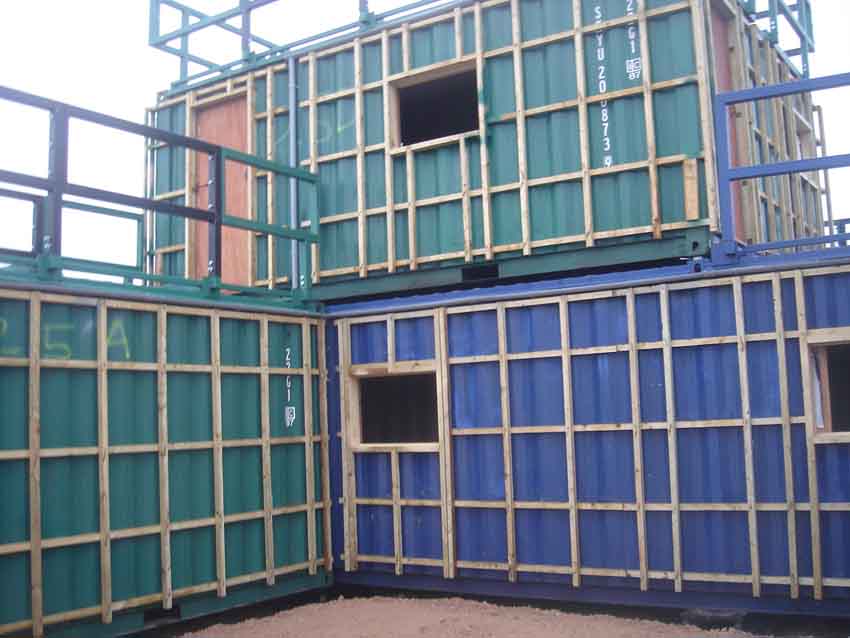
Modular buildings are delivered as units that construction teams position and stack on-site. Walls, windows and even plumbing are constructed in the factory in ideal conditions, creating sealed units the perfect size to fit on the back of a lorry. These can be stacked to form multi-storey buildings and attached side by side to increase floor space.
The success of a modular build rests on the quality of the foundation. With improper support, modules can settle incorrectly, developing serious problems such as leaks, cracks or compressed doorframes. The wrong foundation causes structural issues.
If a module is not correctly supported, floors can become uneven or begin squeaking. Doors and windows may lose alignment, causing them to stick or fail to close fully. Internal fittings such as partitions can take more strain than they are designed to handle, leading to cracks. External cladding can develop gaps, ruining both the building’s appearance and insulation. Leaks, draughts or even pests are all risks.
Modular buildings, whether short-term or long-term, should be installed on a level surface. While uneven ground is a possible base for short-term structures, if you intend to reuse the building, it’s best to create a flat foundation to avoid these structural problems.
Key Factors to Consider Before Choosing a Modular Building Foundation

Before you settle on a particular type of modular foundation, consider the following constraints. Each build will have specific factors in these areas that will impact your decision, so we have summarised the main issues and factors to consider here.
Site Conditions
Check your soil type at regular intervals, including the bearing capacity and drainage. Any areas where water pools will be more compacted, but this could also cause problems for drainage later. It’s also key to check the groundwater table by digging a hole and seeing where water fills. If the groundwater is high, consider above-ground foundations or deep piling options.
You should also be aware of the topography of the site. Slopes and existing ground irregularities increase your need for accurate levelling at every point, ruling out precast concrete slabs, rafts or steel sheets.
Load Characteristics
Request up-to-date plans of the load characteristics of your modular building. These will include dead loads, live loads, point loads and wind loads. You should also consider how each type of foundation will distribute the loads.
You can usually access diagrams from modular foundation suppliers to show the angle of resolve, which you can use to plan ahead.
Permanence of the Building
If the structure will be present for less than 28 days, it is exempt from building regulations. However, structural damage can still set in during this short time, from settling walls, pressure on window casements and door frames and wind loads. Good foundations are still important if the modules will be used again elsewhere.
You may be using your temporary structure as a workshop. In this case, any heavy machinery will also contribute to the load, causing ground compression as well as damaging the structure if unsupported. In these cases, quality temporary foundations are a reliable solution.
Site Access Constraints and Timeframe
Rapid construction is a key benefit of modular buildings. If your site has a restricted timeframe or if the site is difficult to bring heavy plant onto, the best solution is a modular foundation pad system.
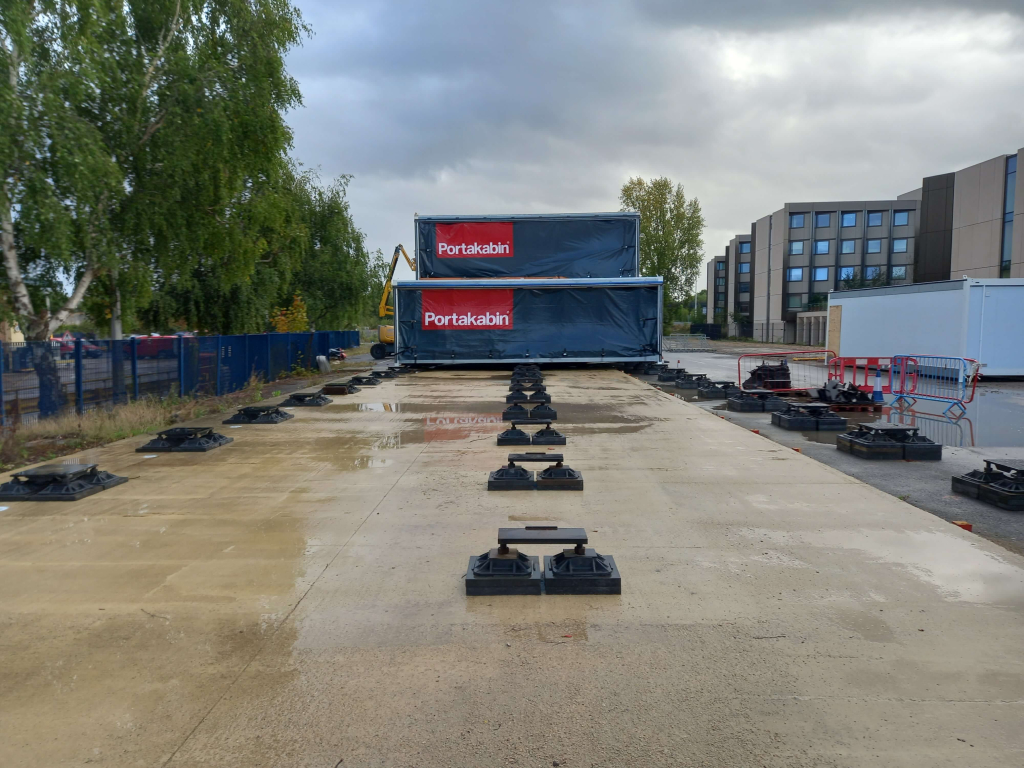
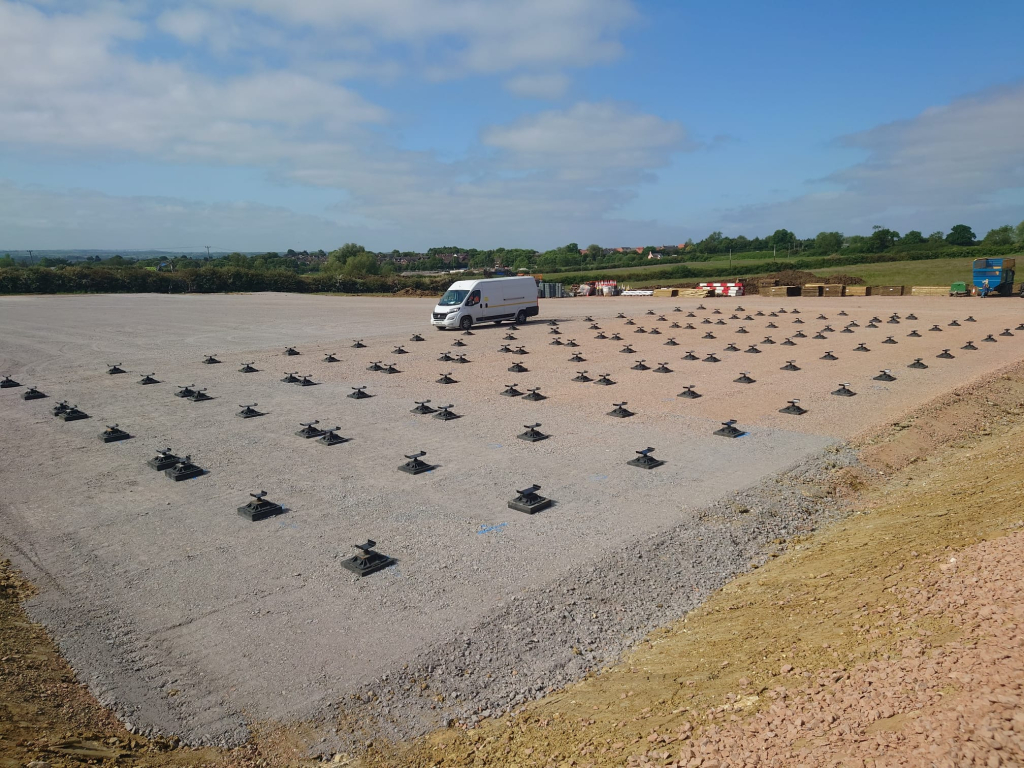
High-density plastic foundation pads can be positioned and adjusted by hand. They sit on the ground surface, removing the need for earthworks or poured concrete.
Budget
Consider how much you want to spend on plant hire, groundworks, concrete and curing time before you can start applying the modules to the foundation. All these factors contribute to the cost of traditional foundations.
Temporary foundation pads can be hired or purchased for a much lower rate than the total cost of conventional concrete groundworks. They’re perfect for smaller budget projects. You can also use them to lower foundation costs so you can free up funding for other features.
Common Foundation Options for Modular Buildings
Concrete Pads
Concrete pads are individual pads placed at the load-bearing points of the structure. They are common on sites with a steep gradient to lower the required digging depth and provide adequate support for flying edges.
In modular homes, load-bearing points extend to entire walls. To support these, add a structural-level platform above the foundation pads.
Ground Screws
Ground screws are large, steel screws that are secured in undisturbed ground. They provide a mounting point that is easily adjusted to achieve a perfect level.
These are ideal where the ground conditions are reliable, but they can be obstructed by large stones or pipe networks. In loose or sandy soil conditions, they can risk tilting, so consider the ground you’re working on before choosing this type of foundation.
Deep (Piled)
Columns of reinforced concrete or steel are driven deep into the ground to create a strong foundation. They are mainly used where the ground conditions are softer, transferring loads to deeper, stiffer soil or rock, resisting horizontal loads. Pile driving can be time-consuming and disruptive to active sites, and is best for large, permanent structures.
Jackpad®
Jackpad® is a type of foundation pad designed specifically to remove the need for groundworks or concrete in foundations. Built from high-density recycled plastic, the units include packers, base plates and adjustable jacks to support perfect levelling. They do not disturb the ground beneath the structure. Instead, they sit on the surface, transferring the load to the ground evenly.
The Jackpad® system is reliably used for short-term and long-term structures. It can be hired or purchased and is completely reusable once your modular building reaches the end of its lifetime. These are convenient, sustainable and cost-effective foundations.
How to Choose the Right Foundation Pad
Step 1: Site Survey and Geotechnical Investigation
Conduct soil tests throughout the site to create a full picture of the ground conditions. It’s important to understand compression, groundwater levels and possible underground obstructions before choosing foundations for modular buildings. Find our why modular buildings need a foundation here.
Step 2: Structural Input
Consult your modular supplier. They should provide accurate load plans for each module. These should be reviewed by a structural engineer who can advise on which foundation to use.
Step 3: Evaluate Foundation Options
In light of calculations, budget, timeline and site disruption, assess each type of foundation to choose the system that is right for you. Consider the factors above, and decide whether groundworks, concrete pouring and long curing times are really necessary for your build.
Step 4: Check Suitability Again
It pays to double-check. The safety of your modular foundation is a high priority, so once you have chosen the foundation type, further checks will be required.
At Jackpad®, we arrange third-party assessments before construction, giving all stakeholders peace of mind.
Common Pitfalls and How to Avoid Them
There are several factors that could lead to problems with your build.
Overlooking Soil Variability
Don’t assume conditions are uniform throughout the site, as soil can be affected by factors as diverse as proximity to trees or roads, water drainage, previous land use and flooding.
Poor Levelling
Incorrect levelling can lead to misalignment of the modules. Like all buildings, modular buildings take some time to settle. If the foundation is not level, this can lead to structural issues, as discussed above.
Delays Due to Curing Time
Poured concrete foundations take time to cure, which can be longer than expected if the ground is cold or there is excess moisture.
You can avoid delays by opting for precast or non-concrete foundations, which are ready to use as soon as they are confirmed to be level.
Inadequate Drainage or Membrane Detailing
Allowing water to pool around the foundations increases the risk of degradation. Freeze-thaw erosion affects concrete, opening cracks and allowing tree roots to take hold.
With precast or poured concrete, waterproof membranes are essential to avoid water ingress.
Plastic foundation pads are waterproof in and of themselves and sit above the surface, so there is no need for concerns about drainage or waterproofing.
Under‑Estimating Cost Contingencies
At the outset of a modular build, underestimating your costs can have knock-on effects on the rest of the project. Poured concrete foundations often come with added complications. These increase your costs. When you have to use your contingency fund at the foundation phase, it’s likely you will have to make cuts to expected features, such as solar panels, roof insulation or EV charging points.
Poor Coordination
Failing to coordinate between the modular supplier and the foundation designer can mean your whole foundation design has to change at the last minute. If your foundation design is based on inaccurate load calculations, for example, your modular build will sink, tip or even crack. Make sure your modular supplier confirms the structural load with the foundation designer to be certain plans are accurate.
Failing to Allow Adjustability or Future Re‑Use
For short-term structures, you don’t need a permanent foundation. Avoid leaving concrete foundations in the ground or creating unnecessary waste by choosing reusable foundation pads.
Jackpad® will collect your foundations once you’re finished and use them for future projects.
Choose Jackpad® For Your Foundation Pads
Not only are reusable foundation pads more convenient and adjustable than concrete, but they’re also a sustainable choice. Concrete has high associated CO2 emissions, and it is what makes the construction industry one of the most responsible for climate change worldwide.
Remove concrete and groundworks from your construction with reliable foundation pads made from recycled materials. View the Jackpad® System, or contact us for a free, no-obligation quote. Alternatively, give us a call today on 0116 286 6966 or email enquiries@jackpad.co.uk