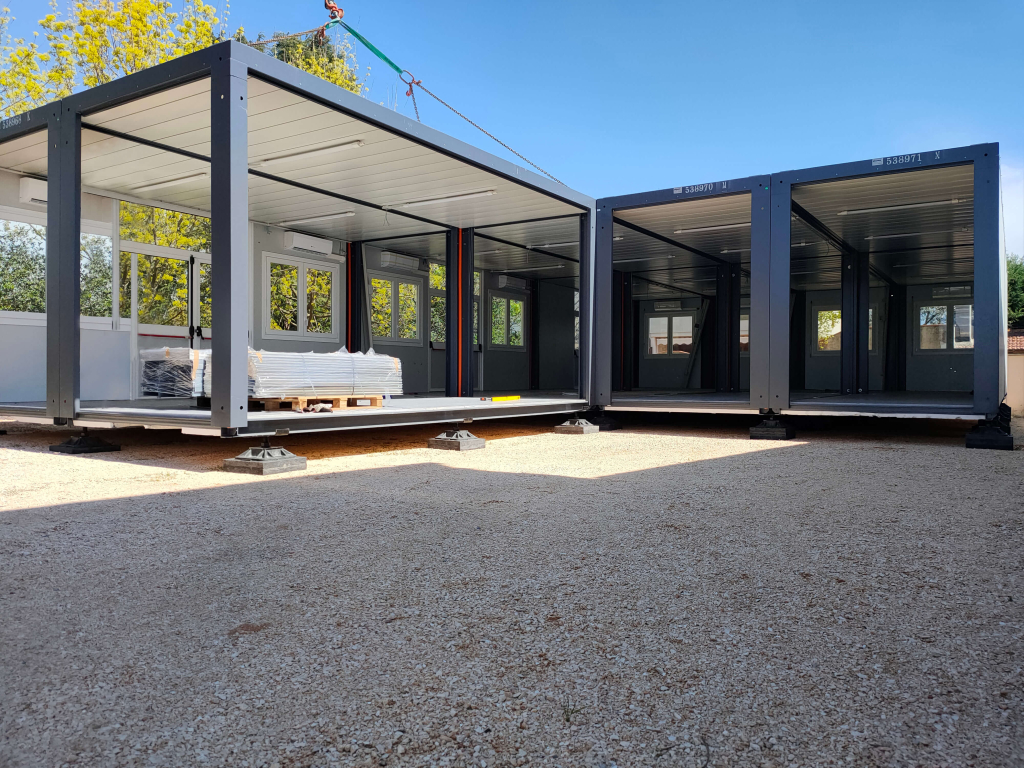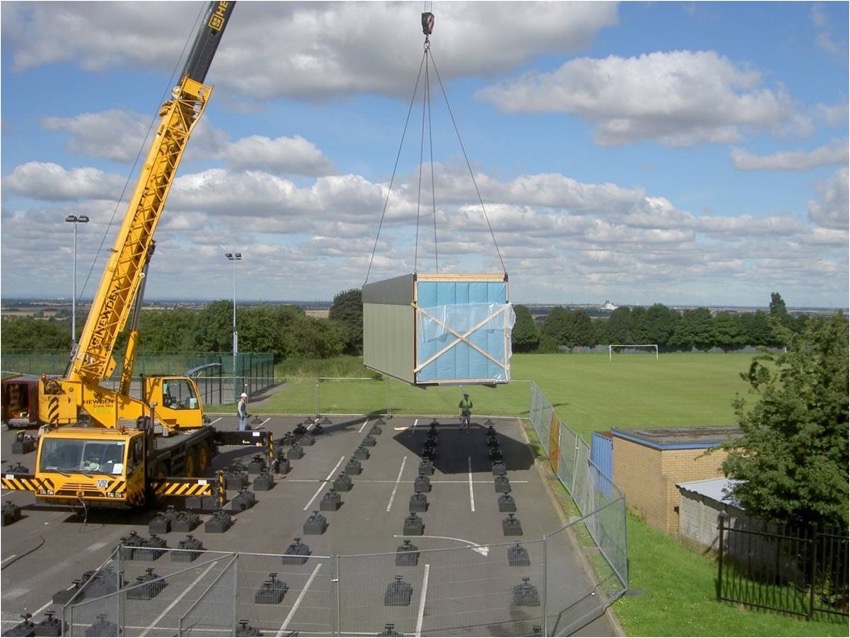
Compared with conventional concrete foundations, modular foundations can at first appear insubstantial. They’re much smaller, they have moving parts, yet they’re used to support entire building structures. Many people initially ask whether modular foundations are safe at all. How much weight can they support, and do they shift or sink over time?
In this blog post, we’ll set those fears aside. Our Jackpad® modular foundation system has been used to support short-term and long-term structures since 2000, and we remain a market leader in alternative foundations because our product is safe and reliable.
What Makes a Foundation ‘Safe’?
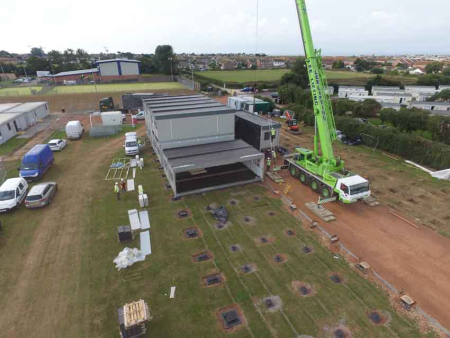
The purpose of a building foundation is to distribute the weight of the structure evenly across the underlying surface. Over time, there may be shifts in the ground beneath a building due to swelling, shrinking, freezing, tree root incursion, erosion, lateral forces and compaction.
So, a safe foundation is a combination of design, materials, installation and ongoing performance. Foundations must be able to bear the load of the structure, so what is safe for a timber garden room is not the same as safe for a multi-storey retail unit. They must also distribute the load evenly to prevent sinking. One of the biggest considerations is the relationship between the load and the ground-bearing capacity.
Safety Standards & Building Compliance
National and Local Building Regulations
In the Building Regulations 2010 (Schedule 1), the government lays out construction requirements, stipulating that all buildings should be constructed so that the combined loads are safely transmitted to the ground without causing deflection or deformation of the building or ground movement. Buildings shall also be constructed so that ‘ground movement will not impair the stability of any part of the building.’
Modular foundations are proven to meet these requirements, as they do not deform the ground or the building, and help prevent the building’s stability from being impaired by ground movement.
Temporary buildings are indeed included in the list of exempt buildings under these regulations. However, the legal definition of a temporary building is limited to a period of 28 days, and any structures intended to remain longer than this are subject to the same regulations as any other.
Engineering and Design Considerations
For foundations to be deemed safe, they must be fully calculated by an independent structural engineer, specifically for each project. This is the same for traditional concrete and foundation pads, with project-specific calculations and informing the number and configuration of pads required for safe building installation.
These calculations include the load path and the load-bearing capacity of the ground. The load path maps the area that will receive the load from the foundation, usually at a 45° angle downwards, to ensure no pipelines or other structures will be impacted. This is called the angle of resolve.
For smaller modular buildings, a foundation system can be used safely on tarmac, concrete and compacted gravel, depending on the load. They are excellent for portable buildings or when ancillary structures require quick construction. With a full inspection and sign-off by a certified structural engineer, the foundation will be considered safe.
Modular vs Traditional Foundations: Key Differences
Traditional concrete foundations are time-consuming and resource-intensive, and while they are conventional, there are not many benefits. Instead of digging trenches, filling them with concrete and waiting for it to cure, many construction projects can be completed successfully with strong foundation pads.
Modular foundations come in many shapes and sizes, with the main feature being that they are precast in standard shapes and can be configured as needed for your modular build. They still require a high level of foundation design to account for the ground conditions in your precise location.
Most types of modular foundations can also be removed when the building reaches the end of its lifetime and reused elsewhere, whereas concrete foundations remain in the ground.
Read our full article on the benefits of non-invasive foundations here.
Common Types of Modular Foundations and Their Safety
Concrete Slabs or Rafts
Precast concrete slabs are highly secure and can be quickly placed at corner points and along main beams. However, there are several challenges with concrete blocks, pads or rafts:
- Levels are inconsistent, as increments are often larger than required.
- Water run-off and drainage are hard to manage, leading to damp, erosion and ground swelling.
- Blocks are difficult to prevent from sinking where minor deviations in ground quality are present.
- Once installed, opportunities for adjustment are limited, which can lead to instability later on.
Concrete Ring Beam Foundations
Ring beam foundations are a single trench around the building’s perimeter, reinforced with steel and shuttering and cured for several weeks. While these are stable, they are time-consuming to create and involve significant skill to achieve a level surface.
Steel Base Plates
Steel plates are useful on softer ground as they spread loads across larger areas. However, the ground must be levelled as any deviation in height will reduce stability. Wet conditions can also cause slippage, which is highly dangerous for any structure.
While it is removable and more sustainable than concrete, steel base plate foundations are not considered safe foundations in the long term.
Adjustable Jackpad® Systems
The market leader is Jackpad®. Our modular foundation system is comprised of portable, solid packers of recycled plastic, a support block and a threaded steel adjuster with a receiving plate.
Any number of packers can be stacked to overcome gradients or depressions in the ground. While concrete modular foundations are held together with cement, Jackpad packers are fitted with interlocking lugs to lock together securely and prevent slippage. Their robust plastic construction makes them strong enough to manage high loads and multi-storey buildings, and they do not slip or shift in wet conditions.
Risks and How They’re Mitigated
Common issues with modular foundations include settlement, poor levelling, water ingress and inadequate load transfer. With careful planning, qualified calculations and correct installation, Jackpad® systems prevent all of these problems.
No groundworks are required in most instances, because our system is infinitely adjustable. The strong recycled plastic construction is non-porous, so there is no risk of water ingress causing cracks or erosion. Like any other foundation system, Jackpad® installations are based on an independent structural engineer’s calculations, including ground assessment, and receive a full inspection and certification during foundation installation to ensure load transfer is adequate.
Choose Jackpad® for Your Foundation Pads
We provide a full turnkey service from supply to installation. These pads have reliably supported short-term and long-term structures since 2000, providing a proven, accredited and time-tested concrete alternative. We conduct all site inspections, receive full calculations from an independent structural engineer, design the layout and complete the installation. We’ll also collect the system when it is no longer needed to reuse or recycle.
For your project to include safe, modular foundations with little to no ground or remedial works required, Jackpad® is the most cost-effective solution. Contact our team for advice or to get a quote. Alternatively, send us an email to enquiries@jackpad.co.uk .